
Institutional Child Abuses
Since 2012, I have been running an international research and implementation programme on addressing and preventing child (sexual) abuses through restorative justice. My focus has been on institutional abuses such as those that occurred within the Catholic Church. The programme includes casework support and advice, primary and second research, evaluation of cases, policy work and direct interventions. It has resulted in several publications in peer reviewed journals and books as well as generating evidence for various commissions and investigations that have been taking place around the world (e.g. Australia, the UK).
"Institutional (child) sexual abuse is real and has penetrated the core of our modern societies. It involves the person entrusted with protecting a child, violating their position of power. School teachers, spiritual leaders, parents, family members, doctors, scout leaders, and coaches have all been included in the list of perpetrators."
Theo Gavrielides Tweet
Advocacy & Advisory work
- 2018 – Advisor to the UN Office on Drugs and Crime (UNODC) on “The Rehabilitation and Reintegration of Children Victims of Recruitment and Exploitation by Terrorist and Violent Extremist Groups”, UN
- 2011 -12: Advisor on the Middle East Young Arab Research Network programme, British Council & 7 Arab Governments, Middle East
- 2006 – 9: EU-Council of Europe, Youth Policy Expert Group, CoE
Publications
- Gavrielides, T. (2012) “Clergy Child Sexual Abuse & the Restorative Justice Dialogue“, Journal of Church and State, Volume 55, Issue 4, 1 December 2013, Pages 617–639, https://doi.org/10.1093/jcs/css041.
- Gavrielides, T. (2012) “Clergy sexual abuse: the restorative justice option” in K.V Wormer & L. Walker Restorative Justice Today: Applications of Restorative Interventions, Sage: California;
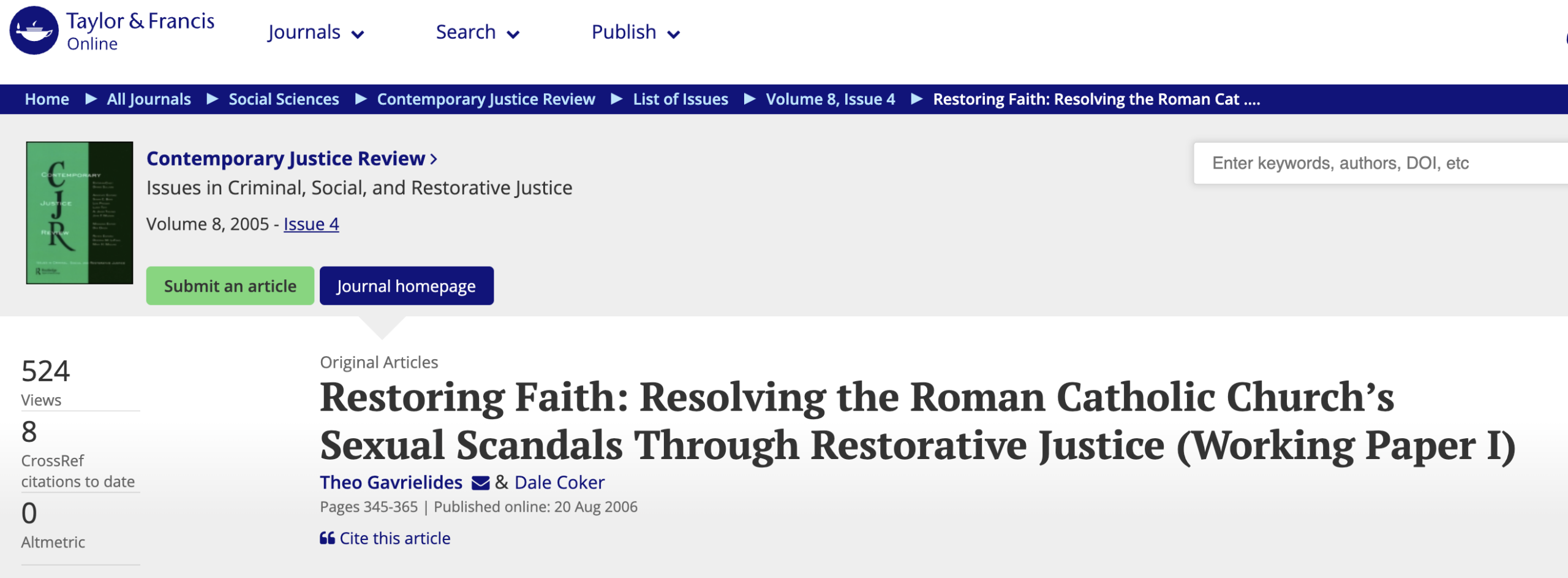
- Gavrielides T. and D. Coker (2005) “Restoring Faith: Resolving the Catholic Church’s Sexual Scandals through Restorative Justice”, 8:4 Contemporary Justice Review, pp. 345-365. ISSN 1028–2580 (print) /ISSN 1477–2248.
Clergy Child Sexual Abuse & the Restorative Justice Dialogue
Much has been written about clergy child sexual abuse within the Catholic Church. This is not to suggest that abuse by members of other religions and denominations has not also been a reality for some time. The sex abuse crisis within the Catholic Church surfaced first, and hence it has been attracting researchers, policy makers, politicians and public’s attention since 1985. The Lousiana case of Gilbert Gauthe was one of the first that came to light; a parish priest who repeatedly molested young boys. Since the 1960’s, Gauthe was transferred from parish to parish, until he was finally convicted and removed from priesthood. He was sentenced to 20 years in prison. After 10 years, he was released only to be imprisoned again. The scale of clergy child sexual abuse within the Catholic Church is extensive. In the US alone, in 1950-2002, 4,392 priests were the subjects of allegations of sexual abuse that were not known to be false. This accounts for 4% of all clergy in the 50 year period. These allegations involved 10,667 victims. 226 of these cases were criminally charged and 138 were convicted. Civil law suits were far more common reaching $573 million for compensation.
My work aims to challenge how cases of child sexual abuse within institutions (including the church) are handled. To this end, I make three new arguments that I substantiate through evidence, fieldwork and case work. Firstly, these cases extend beyond the breach of state laws. They have multiple psychological and existential implications and constitute a violation of victims’ faith, identity and basic human right to dignity, as well as the sacramental culture of Catholicism. Secondly, due to this additional dimension, the impact of clergy child sexual abuse cases on all parties involved can best be mitigated through user-led reconciliation processes such as “dialogue”. Thirdly, one form of such a dialogue could be restorative justice. Its potential as an alternative model to traditional litigation and station action are examined.

Child Sexual Abuse
While there is no universal definition of child sexual abuse, the American Psychological Association describes it as: “The dominant position of an adult that allows him or her to force or coerce a child into sexual activity. Child sexual abuse may include fondling a child’s genitals, masturbation, oral-genital contact, digital penetration, and vaginal and anal intercourse. Child sexual abuse is not solely restricted to physical contact; such abuse could include noncontact abuse, such as exposure, voyeurism, and child pornography.” The CPS provides separate guidelines for prosecuting cases of child sexual abuse, emphasising the gravity and unique nature of these crimes.
Restorative Justice
… is an ethos with practical goals, among which is to repair harm by including affected parties in a (direct or indirect) encounter and a process of understanding through voluntary and honest dialogue. Restorative justice adopts a fresh approach to conflicts and their control, retaining at the same time certain rehabilitative goals” (Gavrielides 2007: 139). The possibility of entering into a dialogue and sharing power with survivors opens the door to the church, the victims and the state for alternative solutions other than those available within the current punitive paradigm of criminal justice. My work explores whether one of these forms of dialogue could be restorative justice.
Institutional abuse
Institutional/ clergy sexual abuse has additional implications for the victim-survivor. It also entails a violation of their faith, family structure, sense of identity and place in the world. This violation may manifest itself through various forms of additional psychological, neurological and emotional effects. Scientific studies quoted suggest that a number of survivors who had experienced the pursuit of justice through state laws – whether civil or criminal – continue to experience a lingering feeling of state neglect and pain. For the institution (church) it also entails a violation of the Church’s sacramental culture and indeed Christ. These implications are almost impossible to mitigate or indeed put right through the formalised structure of state-controlled justice processes. Since 2004, I have been looking at the potential of restorative justice with clergy child sexual abuse cases that occurred within the Catholic Church and other faith institutions. This work started in the USA and now continues in the UK and other countries. It is also intended that evidence-based models can be developed for replication.