International Restorative Justice Week 2026: #rjweek annual blog
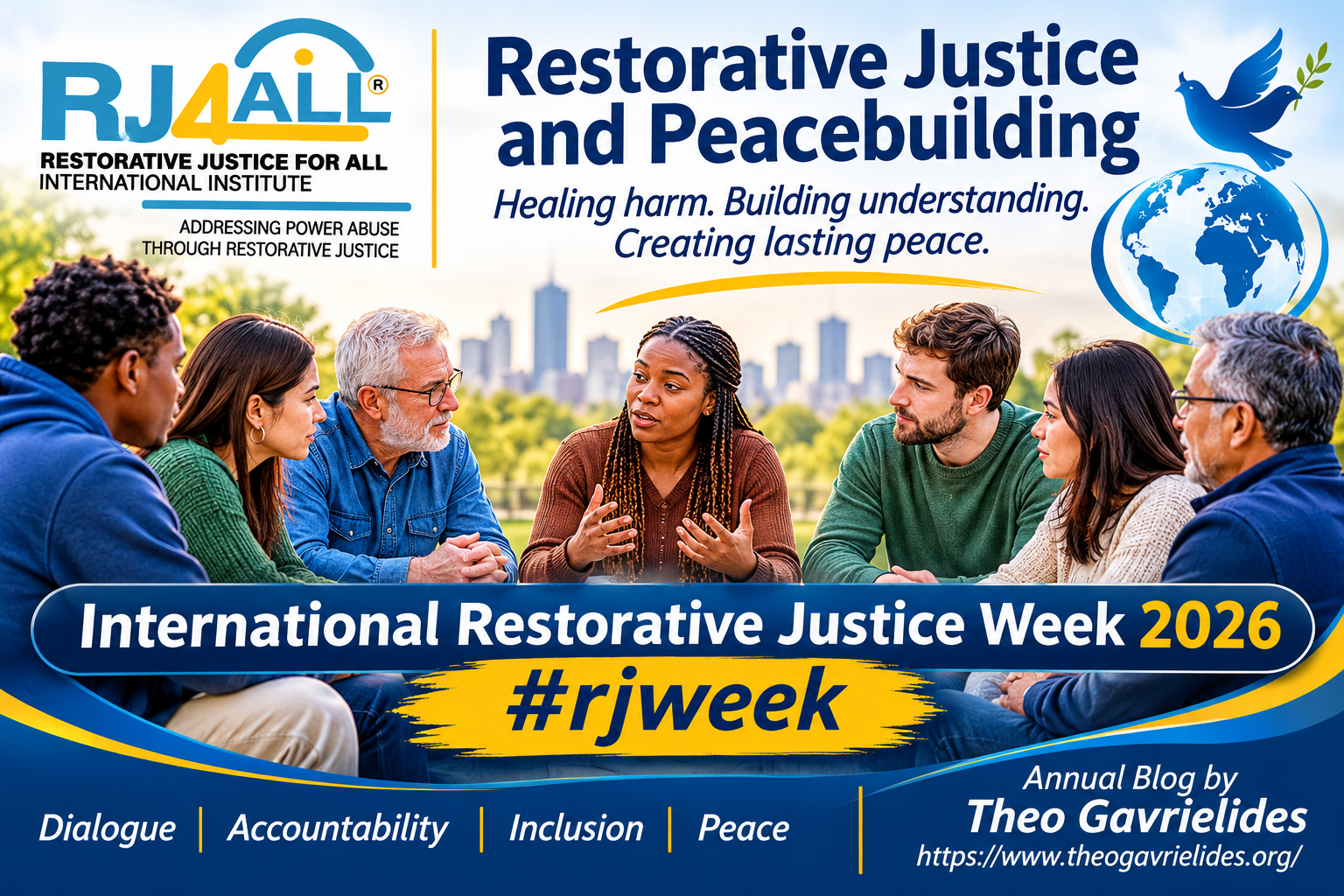
Happy International Restorative Justice Week 2026!
I have been writing annual blogs for #rjweek since 2012! helping to turn the Canadian ‘restorative justice week’ to ‘international restorative justice week’. Each year provides an opportunity not only to celebrate restorative justice and acknowledge the dedication, and commitment of those who have contributed to its development, but also to pause, reflect and critically examine where we are heading.
Celebration is important, but so is self-reflection. We should be prepared to question our assumptions, challenge established practices and consider whether our commitment to restorative justice is reflected in the ways we approach conflict, justice, reconciliation and peace.
For this year’s International Restorative Justice Week, I have chosen Restorative Justice and Peacebuildingas the overarching theme. I have been horrified and often depressed with the escalation of wars and conflicts in every corner of the world. At the same time, I have been inspired and motivated by the sacrifices of so many communities using the restorative justice value of power sharing. It was therefore fitting to dedicate this year to them and peace.
Peace: More than the absence of war
Throughout human history, peace has inspired poets and writers, philosophers and academics, practitioners and communities. It has been the subject of political negotiations, international agreements and social movements. Yet peace is much more than the absence of war or the cessation of hostilities.
Peace is a complex and deeply personal experience. Having experienced conflict in my own home country, I can safely say that peace is also a journey of learning about ourselves and others. It requires us to confront our memories, acknowledge our differences, understand the experiences of those around us and recognise the relationships that connect us.
The absence of peace can have profound short- and long-term consequences. These extend beyond individuals to families, communities, inter-community relationships and entire states. Trauma, mistrust, displacement, inequality and unresolved grievances can survive long after the formal end of a conflict.
This raises an important question: Can we genuinely speak of peace when the conditions that created conflict, injustice and division remain unaddressed?
For restorative justice, this is not simply a philosophical question. It goes to the heart of what justice should achieve.
Justice, international law and the missing dimension of peacebuilding
Justice should not be reduced to the mere application of the law. While legal frameworks are essential in regulating conduct and protecting rights, they cannot, on their own, guarantee meaningful reconciliation or sustainable peace.
This becomes particularly apparent in the context of international law and armed conflict.
Traditionally, international legal discourse has distinguished between jus ad bellum (the law governing the resort to force), jus in bello (the law regulating conduct during armed conflict) and jus contra bellum (the prohibition and prevention of war). Although these areas have developed over time, the normative and practical framework governing what happens after conflict remains comparatively underdeveloped.
The concept of jus post bellum, or justice after war, seeks to address this important dimension. However, peacebuilding remains an area in which political interests, financial considerations, nationalism and racism can significantly influence the process.
The absence of sufficiently robust and consistently applied principles creates opportunities for abuses of power. History demonstrates how colonial powers have used political and economic dominance to shape territories, institutions and financial arrangements, often leaving communities with long-lasting trauma and unresolved claims (Castro-Gómez et al., 2023; Moudouros, 2025).
The question is therefore not simply how wars end, but who determines the terms of peace, whose interests are protected and whose voices remain unheard.
The example of Cyprus: When peacebuilding becomes an instrument of power
One particularly important example is Cyprus (Moudouros, 2025).
Following centuries of complex history and British colonial rule, Cyprus gained independence in 1960. However, independence did not necessarily translate into freedom from external influence.
Following the 1974 coup and subsequent Turkish invasion, the role of the three guarantor powers – Britain, Greece and Turkey – became particularly significant. Rather than necessarily operating as impartial facilitators of peace, their respective political and strategic interests influenced the circumstances surrounding the island and its future (Michael, 2020).
Turkey invoked the coup as justification for its military intervention, while Britain’s strategic interests, including the continued presence of its Sovereign Base Areas, remained an important dimension of the post-independence landscape.
More than five decades later, Cyprus remains divided. The consequences of conflict continue to affect individuals, families and communities on both sides of the divide.
This illustrates a fundamental problem with peacebuilding: the people most affected by conflict are not always the people who determine the terms of peace.
The Cyprus experience also invites us to examine the relationship between external political interests and local responsibility. Peacebuilding can be undermined not only through the active abuse of power but also through the silence, acquiescence or marginalisation of affected communities.
This is a difficult conversation, but one that needs to take place.
My forthcoming book (Gavrielides, T. (2027), Inter-community & inter-state conflicts: Restorative Justice Peacebuilding, Switzerland: Palgrave Macmillan) seeks to contribute to this conversation by challenging established assumptions about peacebuilding and questioning the power structures that influence its practice. It aims to break the silence surrounding these issues and encourage a more critical, inclusive and restorative approach.
The restorative justice community: Building relationships through care
At the heart of restorative justice is the recognition that human beings are connected through relationships. These relationships create responsibilities, obligations and a sense of belonging.
The existence of a restorative justice community is therefore a prerequisite for meaningful engagement between individuals and the wider social structures within which they live.
Such communities may bring together people directly affected by conflict, divided communities, researchers, policymakers and academics. Their purpose should not be to exercise control or reinforce existing hierarchies of power. Rather, they should nurture relationships based on care, mutual dependency, respect and responsibility.
I refer to this as the liaison that connects individuals and communities.
This liaison is not simply a social connection. It is a relationship that gives individuals meaning and encourages them to respect and protect the bonds that connect them with others.
A community founded on care can educate individuals, promote responsibility and encourage those who have violated relationships to recognise the consequences of their actions. It can also create opportunities for individuals and communities to rebuild connections that have been damaged or destroyed.
This is particularly important in situations of conflict, where relationships are often reduced to opposing identities, historical grievances and competing political narratives.
Restorative justice offers an alternative. Through dialogue, listening, acknowledgement and participation, it creates spaces in which people can begin to understand one another without necessarily having to agree on everything.
It is through these relationships that the foundations of reconciliation and peacebuilding can emerge.
The Greek Symposium tradition: Learning, dialogue and restorative living
The intellectual foundations of my forthcoming book are closely connected to the 2025 International Symposium of Restorative Justice, entitled ‘Inter-community and Inter-state Conflicts: Peacebuilding and Reconciliation’.
The Symposium was part of a series of international gatherings inspired by the ancient Greek practice of the symposium. Previous events took place in 2012, 2014 and 2016, continuing a tradition of bringing people together for intellectual exchange, dialogue and shared reflection.
The fourth Symposium brought together in Cyprus 18 scholars and practitioners from nine countries: New Zealand, Australia, South Africa, the United States, Brazil, Italy, the United Kingdom, Greece and Cyprus.
Over six days, participants developed strong personal and intellectual connections. These relationships provided the foundation for candid, challenging and often courageous discussions about the contribution of restorative justice to peacebuilding.
Importantly, the Symposium was not simply an academic conference. It was an experience of collective learning and relationship-building, necessary ingredient for peace within.
The participants were encouraged to challenge one another’s positions, share their research and engage with different perspectives. The friendships established during those six days became an important part of the intellectual process informing the book.
This is what I understand by sympotic and restorative living: an approach that recognises the importance of relationships, shared experiences, dialogue and mutual learning in the pursuit of justice and peace.
The Symposium demonstrated that intellectual exchange does not have to be detached from human relationships. On the contrary, meaningful academic debate can be strengthened by trust, friendship and a willingness to listen.
Restorative justice as a practice of peacebuilding
The relationship between restorative justice and peacebuilding should not be understood merely as the application of restorative practices to situations of conflict.
It requires a deeper reconsideration of how we understand justice, power, responsibility and community.
Restorative justice can contribute to peacebuilding by:
- Creating spaces for affected individuals and communities to share their experiences.
- Recognising the harm caused by conflict, including historical and structural injustices.
- Encouraging accountability and responsibility beyond the formal boundaries of legal institutions.
- Rebuilding relationships and strengthening connections between divided communities.
- Challenging unequal power relations and ensuring that marginalised voices are heard.
- Promoting dialogue, mutual understanding and collective learning.
Practices such as restorative circles can provide opportunities for people to come together, listen and engage with difficult questions in a structured and respectful environment.
However, restorative justice must also remain critical of the circumstances in which it operates. It cannot become another instrument through which powerful actors impose predetermined outcomes or silence legitimate grievances.
Restorative processes must be voluntary, inclusive, attentive to power imbalances and grounded in the experiences and needs of those affected.
Peace cannot be imposed through the language of reconciliation. Nor can it be achieved by asking victims and affected communities to move forward without acknowledging the injustices they have experienced.
A final reflection: Breaking the silence
As we celebrate International Restorative Justice Week 2026, I would like to return to the importance of self-reflection.
We should celebrate the achievements of restorative justice and recognise the dedication of those who have contributed to its development. But we must also be prepared to question our own practices and challenge the structures that prevent meaningful justice and reconciliation.
Peacebuilding is not simply about ending conflict. It is about understanding why conflict happened, acknowledging the harm it caused, addressing the inequalities that sustain it and creating the conditions for relationships to be rebuilt.
The experiences of Cyprus and other conflict-affected societies remind us that peace processes can reproduce the very power imbalances they claim to resolve. They also remind us that the voices of local communities must not be marginalised in decisions concerning their own futures.
My hope is that the work emerging from the 2025 International Symposium, and the book it has inspired, will contribute to a more critical and restorative understanding of peacebuilding.
Ultimately, restorative justice is not simply about repairing harm after relationships have been broken. It is also about creating communities in which relationships are valued, protected and nurtured.
Perhaps the most important question for this year’s International Restorative Justice Week is not simply how we make peace, but what kind of peace we are trying to build, for whom, and at whose expense.
Happy International Restorative Justice Week 2026!
Let us continue the conversation, challenge the silence and work towards a more meaningful, inclusive and restorative understanding of peace.
Please consider signing my Peace Letter to world leaders. The more signature the stronger our collective voice. You can do this by following this link (all data protected).
#RJWeek #